Oakland Furniture WordPress-to-Squarespace Website Rebuild
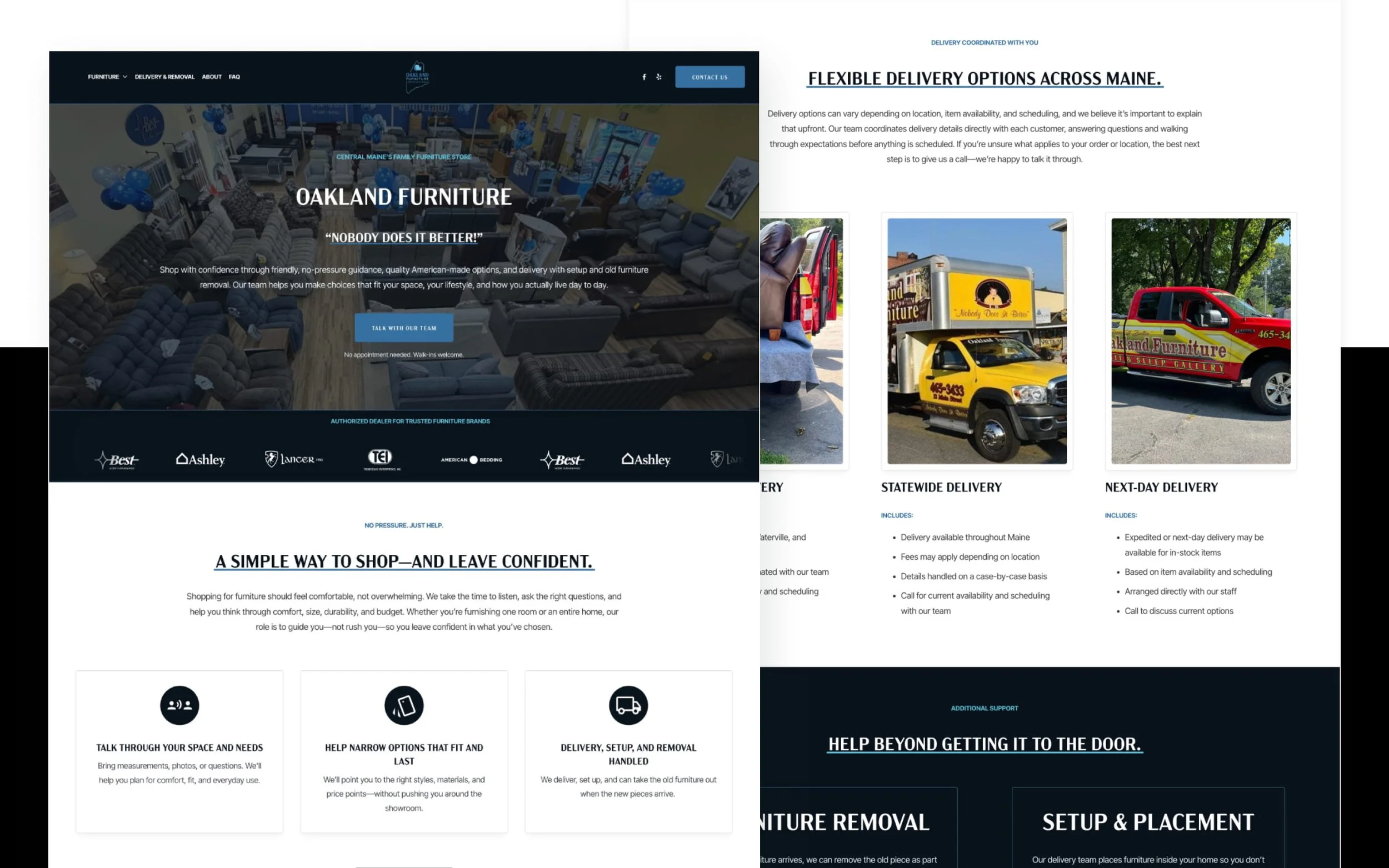
The rebuilt Oakland Furniture website helps customers browse furniture categories, understand delivery options, and connect with the showroom.
Oakland Furniture is a family-owned furniture store in Oakland, Maine, serving Central Maine since 1999. When owner Kelly Breton contacted Haskell Digital Services, the company’s WordPress website no longer represented the business she had worked to reshape after taking ownership from her late father.
The website looked outdated, performed poorly on mobile devices, and did not accurately explain what customers could expect from the store. Rather than selling furniture online, Oakland Furniture needed a website that would build trust, answer practical questions, and encourage people to call or visit the showroom.
HDS migrated the business from WordPress to a new 10-page Squarespace website, creating the design, content, page structure, and search foundation through our Out-of-the-Box Web Design service.
Project Snapshot
Client: Oakland Furniture
Location: Oakland, Maine
Industry: Furniture retail
Project type: WordPress-to-Squarespace website migration and rebuild
Platform: Squarespace 7.1
Timeline: January–early February 2026
Pages: 10
Service: Out-of-the-Box Web Design
Ongoing service: $199/month Managed Website Service
HDS responsibilities:
Website strategy and information architecture
Visual design and color direction
WordPress-to-Squarespace migration
Squarespace development
Website copywriting
Mobile optimization
Category-page system
Image optimization and metadata
Foundational SEO, AEO, and GEO setup
Accessibility improvements
Custom CSS
Elfsight widget configuration
FAQ structured data
Launch coordination
Ongoing website support
An Outdated Website for a Business That Had Changed
Kelly found HDS through Google while looking for a local web design company. She wanted to work with someone nearby who could understand the business, guide the project, and continue supporting the website after launch.
Oakland Furniture’s old WordPress website had fallen behind the company itself. Kelly had made significant changes to the business after taking ownership, but the website still reflected an earlier version of the store. Its design felt dated, its navigation was difficult to use, and its mobile experience made it harder for prospective customers to find useful information.
The problem was not simply visual. The old website no longer communicated what Oakland Furniture offered or why customers continued choosing the independent showroom over larger retailers.
Kelly did not need a fully custom website or online store. She chose HDS’s Out-of-the-Box Web Design service because its defined scope fit the project, and she trusted us to establish the design and content direction.
Designing Around Showroom Visits Instead of Online Orders
Oakland Furniture does not maintain an online catalog or process furniture purchases through its website. Inventory changes regularly, and customers benefit from discussing comfort, dimensions, materials, delivery, and availability directly with the store.
That meant the new website could not be structured like a typical e-commerce furniture site.
Instead, we created a trust-first experience designed to help visitors:
Understand the types of furniture available
Learn what makes the store different
Find answers about delivery, setup, and removal
Call the store without searching for contact information
Get directions and visit the showroom
Feel comfortable browsing without sales pressure
Calls and showroom visits became the website’s primary conversions. This decision guided the navigation, page hierarchy, copy, calls to action, and mobile experience.
Establishing a New Visual Direction
Oakland Furniture entered the project with an existing logo but without a complete website design system. Desmond developed the site’s visual direction around that logo, selecting the colors, typography, spacing, borders, and interface treatments used throughout the new Squarespace website.
The design needed to feel established and approachable without resembling a large online retailer. The resulting system uses restrained colors, generous spacing, clearly separated content, and straightforward navigation to keep attention on the store’s service and furniture categories.
Kelly supplied the photography used throughout the site. No stock images were added. HDS compressed the image files, renamed them with descriptive filenames, and added contextual metadata and alt text so the photography would load efficiently and support accessibility and search visibility.
Creating a Clearer Website Structure
The new website was organized around the questions furniture shoppers are most likely to have before calling or visiting.
Its core structure included:
Home
Living Room
Bedroom & Mattresses
Dining Room
Office & Home Décor
Custom Furniture
Delivery & Removal
About
FAQ
Contact and store information
A Lift Chairs category was added later through Oakland Furniture’s ongoing support service.
The category structure allows visitors to begin with the room or type of furniture they need without suggesting that every item is displayed online or currently in stock.
Building a Reusable Category-Page System
Rather than designing every furniture category independently, we first created one complete category-page layout. Kelly reviewed that structure and provided feedback during the revision process.
Once the layout was approved, we duplicated it for the remaining categories and replaced the copy, photography, product information, and brand details.
This system accomplished several things:
It gave Kelly a clear format for supplying information.
It made the build more efficient within the service’s fixed scope.
It created a consistent browsing experience.
It made future categories easier to add.
It prevented individual pages from becoming visually disconnected.
Each category page gives visitors a practical overview of what they may find in the showroom while directing questions about current inventory and availability to the Oakland Furniture team.
Writing the Website From the Ground Up
Desmond wrote all new website copy for the rebuild. Kelly guided the content for accuracy and reviewed it during the project’s two revision rounds.
The writing needed to sound knowledgeable without being pushy. It also needed to explain the benefits of shopping locally without relying on generic claims.
The finished copy emphasizes:
Friendly, no-pressure assistance
Furniture and mattress options for different needs and budgets
American-made options
Local and statewide delivery
Setup and furniture-removal assistance
The store’s history and Central Maine roots
Direct help choosing furniture that fits the customer’s home
The content also sets honest expectations. Visitors are encouraged to call or visit for current inventory, product details, and delivery information rather than relying on an inaccurate online catalog.
Making It Easier to Call at the Right Moment
Because customer conversations are central to Oakland Furniture’s sales process, phone access needed to remain available throughout the browsing experience.
We configured an Elfsight click-to-call widget that appears across the website and works on mobile devices. This gives a visitor an immediate way to contact the store after viewing a category, reading about delivery, or finding an answer in the FAQ.
The website also uses clear call and directions links in high-intent locations. Link labels, tap targets, and button placement were reviewed so visitors would understand where each action leads.
Extending Squarespace With Custom Styling
The website was built in Squarespace 7.1 and extended with custom CSS to create a more distinctive and consistent interface.
The custom styling supports:
Desktop and mobile navigation
Active-navigation states
Hover interactions
Buttons and links
Content cards
Image and gallery borders
Accordion styling
Map presentation
Portfolio-category navigation
Mobile pagination
Dropdown menus
Responsive spacing and typography
The site also includes automatic footer-year code and the Elfsight click-to-call integration.
These additions allowed the website to remain manageable within Squarespace while presenting a design tailored to Oakland Furniture’s identity and customer experience.
Preparing the Site for Mobile and Accessibility
The website was reviewed across desktop and mobile layouts, with particular attention given to visitors who may be trying to call the store, confirm its hours, or get directions from a phone.
The accessibility work followed WCAG-informed practices and included attention to:
Heading hierarchy
Typographical hierarchy
Color contrast
Descriptive link labels
Mobile tap targets
Form usability
Keyboard navigation
Image alt text
Decorative-image handling
Readability across screen sizes
This work did not change how Oakland Furniture operates. It made the information and contact pathways easier for more people to use.
Establishing the Search Foundation
The project included foundational on-site SEO, AEO, and GEO preparation within the scope of the Out-of-the-Box service.
HDS completed:
Page titles and SEO descriptions
Clear heading structures
Search-friendly page organization
Internal linking
Descriptive image filenames and alt text
Category-focused page copy
Location and service-area language
FAQ content based on customer questions
FAQ structured data
Social-sharing information
Indexing controls for applicable utility pages
The goal was not to make unsupported claims about live inventory or turn every page into a search landing page. The goal was to give search engines and AI systems an accurate understanding of the business, its location, its services, and the purpose of each page.
Local-listing management was not included in this project’s scope.
Completing the Project in Four Weeks
The project began in January and launched at the beginning of February, meeting the planned four-week schedule.
Siena managed the project, communicated with Kelly, organized feedback, and acted as the liaison between the client and the website build. Desmond led the strategy, visual design, copywriting, Squarespace development, search preparation, and technical implementation.
Kelly reviewed the website through two organized revision rounds, providing the business-specific guidance needed to keep the copy and service information accurate. Siena also managed the launch process. Because the previous website contained only a small number of pages and did not have equivalent URLs requiring preservation, no additional URL redirects were needed.
A Website That Reflects the Business Today
The completed website gives Oakland Furniture a current, mobile-friendly online presence built around how the store actually serves its customers.
Instead of presenting an incomplete online catalog, the website helps people understand what the store carries, learn how its team can assist them, and take the next practical step.
Kelly described the experience this way:
“I couldn’t be happier with our experience. The service and communication throughout the entire website build were exceptional from start to finish. Siena and Desmond are incredibly knowledgeable, professional, kind, and easy to work with. They truly listened to our needs and delivered a beautiful website that accurately represents our business. I highly recommend them!”
—Kelly B., Owner, Oakland Furniture
The before-and-after comparison below shows the difference between the former WordPress homepage and the new Squarespace design.
Continued Support After Launch
Oakland Furniture remained with HDS through the $199-per-month Managed Website Service included with its Out-of-the-Box website.
Since launch, HDS has continued helping with:
Adding a new furniture category
Writing additional website copy
Creating promotional popups and notices
Updating existing page content
Making smaller design and information changes
This ongoing relationship means Kelly does not have to manage Squarespace, troubleshoot changes, or find a new provider whenever the business needs something updated.
View the Finished Oakland Furniture Website
The new website presents Oakland Furniture as it operates today: an established local store offering practical guidance, quality furniture, delivery support, and a comfortable alternative to big-box shopping.
Visit the Oakland Furniture website.
You can also view more website projects from HDS or read how we handled a larger EvanTell WordPress-to-Squarespace migration.
Does Your Website Still Represent Your Business?
A business can change significantly while its website remains stuck in the past. If your current site feels outdated, performs poorly on mobile devices, or no longer reflects what you offer, Haskell Digital Services can help you determine the right path forward.
Tell us about your business and what you need from your website. We’ll review your project, confirm the scope, and walk you through what comes next.