Best Dance Studio Website Design: What Works in 2026
Dance studio website design has to do more than show beautiful photos and list a few class options.
It needs to help families find the right class, understand age groups and skill levels, check schedules, review policies, and register without confusion.
For dance studios in Maine and New England, your website often becomes the first serious trust check for parents. A family may hear about your studio from another parent, see a recital post on social media, find you through Google, or drive by your location. Before they call or register, they usually check the website.
If the site feels outdated, hard to use, or confusing on a phone, that family may keep looking.
This guide covers what works for dance studio websites in 2026, especially for studios with multiple classes, programs, age groups, skill levels, events, and parent resources. It also explains how our Out-Of-The-Box Athletic & Youth Program specialized website design gives dance studios a stronger starting point without requiring a full custom build.
Why Dance Studio Websites Need More Than a Basic Homepage
A basic dance studio website usually includes a logo, a few photos, a short welcome message, and a contact form. That may confirm the studio exists, but it does not usually give families enough information to choose a class or feel ready to register. Before a parent contacts a dance studio, they often want answers to practical questions.
What classes do you offer?
Which class is right for my child’s age?
Do you have beginner options?
What styles of dance do you teach?
Where can I find the schedule?
How does registration work?
What should my child wear?
Do you offer performances or recitals?
What are your policies?
How do I contact the studio if I have questions?
Dance studios also have a lot of information to organize. Ballet, tap, jazz, hip hop, contemporary, acro, preschool dance, competition teams, summer camps, adult classes, recital details, dress codes, and studio policies can pile up quickly.
If the navigation is weak, families get lost. When families get lost, they either leave the site or message the studio with questions the website should have answered. Social media can help with announcements and photos, but it does not replace a clear website. Instagram is not built to organize classes by age group. Facebook posts get buried. PDFs are easy to miss. A dance studio website should give families one steady place to find the information they need.
What Works in Dance Studio Website Design in 2026
-
The homepage needs to explain who the studio serves, what programs it offers, and how families can take the next step. For a dance studio, this means being clear about class types, age groups, experience levels, and registration. A parent should quickly understand whether the studio offers beginner classes, youth programs, competition options, recreational classes, camps, or adult programs.
The homepage also needs clear local context. You do not need to list every nearby town in the first section. You do need to make the studio location and service area clear enough that families know whether the program is close enough for them. A clear homepage helps the right families stay on the site and move toward registration or inquiry.
-
A dance studio website needs more than one broad classes page when the studio offers multiple programs. Classes should be easy to browse by style, age group, level, or program type. A parent looking for preschool dance should not have to dig through the same page as advanced competition team details. A teen looking for hip hop should not have to scan every youth class to find the right option.
Multiple class and program pages help organize the site around how families search. They also give each program room to explain who it is for, what students learn, when it is available, and how to register.
For SEO, this structure also helps search engines understand the studio’s offerings more clearly. A dedicated ballet class page, summer camp page, or competition team page is easier to understand than one crowded page that tries to cover everything.
-
Navigation matters more for dance studios than many owners realize. A studio with multiple styles, age groups, programs, events, and resources needs a menu that can hold a lot of information without feeling packed. Nested folders help organize related pages under clear categories.
For example, a dance studio could organize navigation around classes, programs, about, resources, events, and contact. Under classes, families could find preschool dance, elementary classes, teen classes, adult classes, summer programs, or class styles. Under resources, they could find dress code, policies, recital information, and FAQs.
This keeps the website easier to use, especially for parents on mobile devices who need quick answers. A strong navigation structure reduces confusion and helps families get to the right page faster.
-
Dance studios often have time-sensitive links that families need fast. A banner or top bar at the top of the website can point visitors to high-priority pages without making them search through the full menu.
This can be used for registration, class schedules, recital information, parent portal links, summer camp signup, auditions, announcements, or weather updates. For studios, this is practical. Families often come to the website looking for one specific thing. A top bar gives them a direct path to the pages or links that matter most at that moment.
-
A dance studio website should make the next step easy. Some visitors are ready to register. Others want to ask a question, view classes, check the schedule, or contact the studio before deciding. The site should give them clear options without making the page feel pushy.
Strong calls to action for dance studio websites may include:
View Classes
Register for Classes
Ask About a Program
Contact the Studio
View the Schedule
Start Registration
These CTAs should appear on the homepage, class pages, program pages, FAQ page, and contact page. A parent should never have to search for the next step.
-
Parents want to know that the studio is safe, organized, welcoming, and worth the commitment. Testimonials help build trust. They can speak to the quality of instruction, communication, student confidence, class environment, recital experience, or how the studio supports families.
A testimonial section on the homepage gives new visitors quick social proof. Testimonials can also work well on class pages, competition pages, or parent resource pages when they match that specific program. For youth programs, trust is not just about skill. It is also about how families feel when they join the studio.
-
Dance studio websites often need to show a lot of information without making pages feel crowded. Dynamic elements can help with that. Card hover states, expanding cards, and reveal sections allow the site to organize details in a cleaner way.
A studio can use these sections to show class descriptions, age ranges, program details, dress code notes, performance information, FAQs, or parent resources. Visitors can scan the page first, then open the information they need. This is especially helpful for studios with many programs. The page can stay clean while still giving families enough detail to make a decision.
-
A dance studio website should help families understand who is teaching and what the studio values. The About page can include the studio’s story, teaching approach, location, contact information, and team details. Staff pages or instructor sections can introduce teachers, their experience, class focus, and role in the studio.
For parents, this matters. They want to know who will be working with their child. A strong About section makes the studio feel established, organized, and approachable.
-
A dance studio website should answer the questions families ask over and over. An FAQ page can cover registration, trials, dress code, tuition, missed classes, recital expectations, communication, class placement, age groups, and policies.
Parent resource pages can include dress code, recital info, class prep, studio calendar, handbook links, performance details, and portal access. These pages save time for the studio team and help families feel prepared. They also make the website more useful after enrollment, not only before registration.
-
The contact and registration path should be easy to follow. A full contact page should give families a way to ask questions, share the student’s age, name the program they are interested in, and provide contact details.
If the studio uses outside registration software or a parent portal, the website should link to it clearly. If registration starts through an inquiry form, the form should ask for the right information. A strong registration flow reduces friction and helps the studio receive cleaner inquiries.
The Problem With Generic Dance Studio Website Templates
Generic website templates can look nice, but they usually are not built around how dance studios organize classes, programs, schedules, parents, and registration. A nice-looking homepage does not automatically solve the hard parts of a dance studio website. The studio owner still has to figure out the navigation, class structure, parent resources, registration flow, program pages, FAQs, staff pages, event information, and ongoing updates.
That is where many dance studio websites become messy. A generic template may give you a visual starting point, but it usually does not give you a clear plan for nested navigation, class and program pages, quick-access links, expanding content sections, parent resources, or long-term support. A dance studio website can look polished and still create confusion for families. The structure behind the design matters.
Our Out-Of-The-Box Athletic & Youth Program Specialized Website Design Solves This
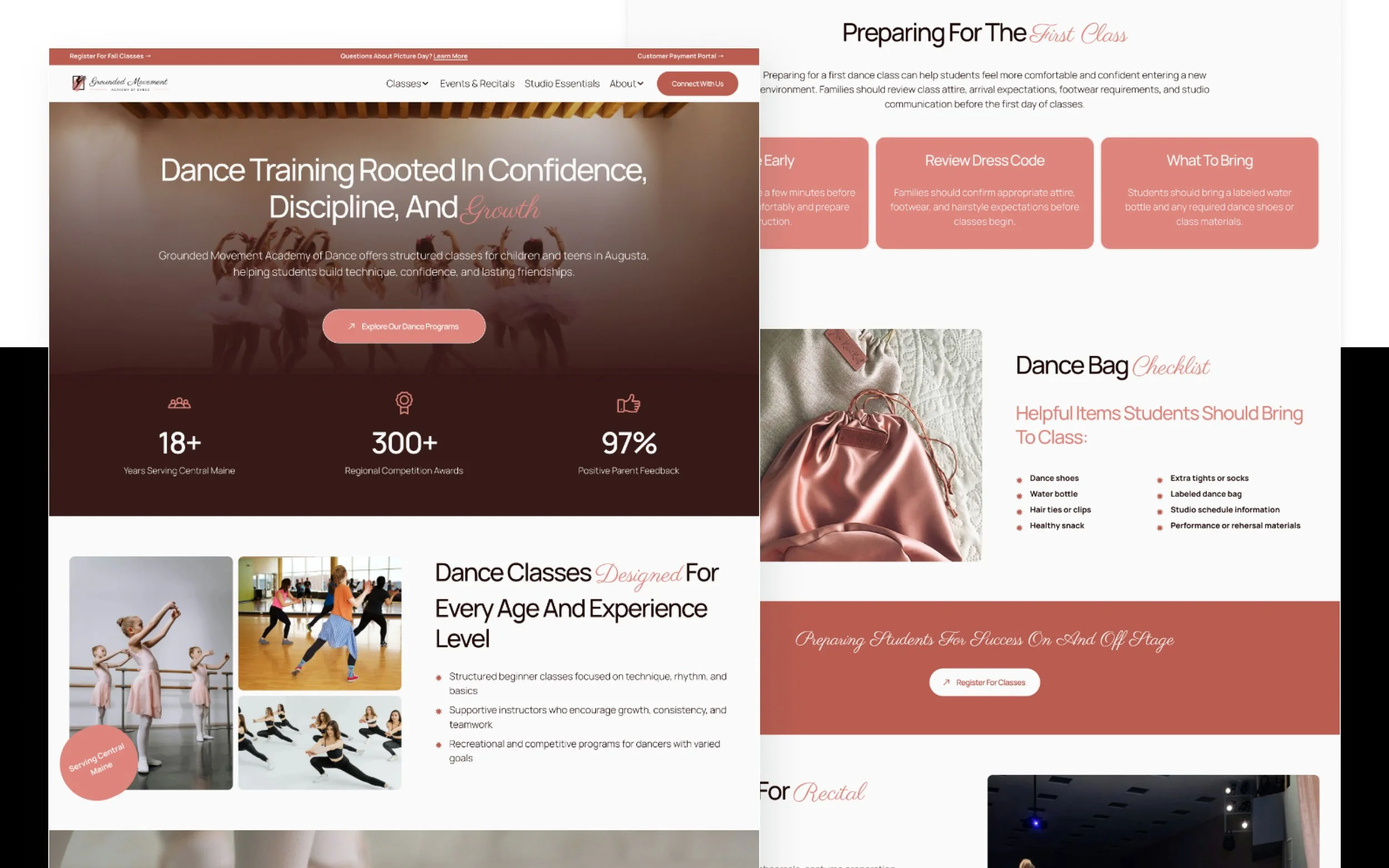
Our Out-Of-The-Box Athletic & Youth Program specialized website design is built for dance studios, gymnastics programs, cheer programs, youth sports organizations, fitness programs, and other activity-based businesses that need a professional website with clear class and program structure. For dance studios, the design gives families an easier way to find what they need. The navigation can use nested folders to organize classes, programs, about pages, parent resources, events, and contact information. This helps the site stay clean even when the studio offers many styles, ages, and levels.
The top banner or bar gives the studio a place to feature quick-access links. This can be used for registration, schedules, parent portal access, recital information, summer camp signup, auditions, or other priority updates.
The design also includes dynamic content sections that help reveal details without overwhelming the page. Card hover states, expanding cards, and nested information areas can be used for class descriptions, age groups, program details, dress code notes, FAQs, and parent resources.
Multiple class and program pages give each offer room to stand on its own. A preschool dance page can speak directly to young families. A competition team page can explain expectations and commitment. A summer program page can focus on dates, age ranges, and registration. A beginner class page can help new families feel more comfortable taking the first step.
This structure matters because dance studios do not run on one simple service page. They need a website that can organize programs, answer parent questions, support registration, and stay useful throughout the year. The design also supports trust-building sections like testimonials, About content, instructor information, FAQs, contact forms, gallery areas, and blog setup. Together, these pages create a dance studio website that supports enrollment, parent communication, local SEO, events, and long-term marketing.
What You Get With the Out-Of-The-Box Package
The value of the Out-Of-The-Box package is that you are not starting from a blank screen and you are not left to manage the website alone. You get an industry-specific specialized website design built around the way dance studios and youth programs organize information, support families, and encourage registration.
The package includes professional setup, mobile-friendly design, planned page structure, launch support, and ongoing website support after the site goes live. For many dance studios, this is a better fit than DIY because the structure is already planned around classes, programs, parent resources, and registration. It is also faster and more cost-conscious than a full custom website project.
Your dance studio website will need regular care after launch, and that is part of why the Out-Of-The-Box package is built around ongoing support. We can help update class information, adjust program pages, add new announcements, update recital or event links, post hiring updates, make content changes, and keep the site aligned with the studio calendar. Instead of handing you a website and leaving you to figure out every update on your own, we stay involved as your long-term website partner.
Is This Specialized Design Right for Your Dance Studio?
The Out-Of-The-Box Athletic & Youth Program specialized website design is a good fit if:
You need a professional website soon
You want something stronger than a DIY site
You offer multiple classes or programs
You need clear navigation for families
You want quick-access links for registration or schedules
You want class and program pages organized clearly
You want dynamic sections for details and parent resources
You do not want to manage every update alone
You want support after launch
It may not be the right fit if:
You need a fully custom brand and website strategy
You need advanced registration software built from scratch
You need complex custom integrations
You have a large content-heavy site
You want to build and maintain everything yourself
You need unusual functionality outside the design scope
For dance studios that need a clean, practical, professionally built website with ongoing support, Out-Of-The-Box Web Design is likely the better path.
For businesses that need a fully custom experience, our Custom Web Design package is the better fit.
Dance Studio Website Design Should Make Registration Easier
The best dance studio website design in 2026 gives families the information they need before they register or contact the studio. Every page should serve a clear purpose, whether it explains a class, organizes programs, answers parent questions, shares a schedule, or points families toward registration. A strong dance studio website should organize classes, support local search, build trust, answer common questions, and make it easy for families to take the next step.
For dance studios, gymnastics programs, cheer programs, and youth activity businesses, that structure can make the difference between a parent leaving confused and a family reaching out to join. If you run a dance studio in Maine or New England, your website should help families understand your programs before they ever send a message.
Our Out-Of-The-Box Athletic & Youth Program specialized website design gives you the structure most dance studio websites need: organized navigation, nested folders, quick-access links, class and program pages, dynamic content sections, FAQs, contact forms, and ongoing support after launch.
FAQ
-
A dance studio website should include a clear homepage, class and program pages, organized navigation, registration links, parent resources, testimonials, staff information, FAQs, schedules, and a contact page. These pieces help families understand the studio and take the next step.
-
The best dance studio website design for enrollment makes classes easy to find, explains age groups and program options, includes clear registration paths, answers parent questions, and works well on mobile devices.
-
A generic website template usually gives you a layout. Dance studio website design needs a structure built around classes, age groups, schedules, registration, parent resources, events, instructor information, and ongoing updates.
-
Yes. Separate class and program pages help families find the right option faster. They also give each class, age group, or program room to explain who it is for, what students learn, and how registration works.
-
A parent resource page can be very useful. It can include dress code information, policies, recital details, calendars, portal links, FAQs, and class prep information. This can reduce repeat questions and make the website more useful for enrolled families.
-
Yes. Social media can help with visibility, but a website gives families one steady place to find classes, schedules, policies, registration links, contact information, and program details.
-
Yes. Haskell Digital Services works with clients on an ongoing support model. That means your website can be updated after launch as your classes, schedules, events, staff, announcements, and content change.