Out-of-the-Box vs Custom Web Design: Which Fits Your Business
Most small businesses treat out of the box versus custom web design as a budget question, but the real deciding factor is functionality, not cost. A template handles any site where the customer journey is find, trust, contact, or buy, and it launches in weeks at a fraction of the price. Custom design earns its cost only when a business needs something a platform truly can't do, like live inventory sync, tiered member access, or a quote calculator built from user inputs. Upfront cost gaps are wide, but total ownership cost narrows the gap considerably once platform fees, maintenance labor, and security responsibility get counted over three to five years. For local search rankings, platform choice sets a technical ceiling, but content, Google Business Profile setup, and reviews determine whether a business gets anywhere near it, which is why most Maine small businesses are better served starting out of the box and moving to custom only once real customer data shows exactly what needs rebuilding.
The out of the box vs custom web design decision usually gets framed as a budget question, and that's the wrong starting point. The better question is whether your business needs a website that does something unusual. If a visitor's path is find you, trust you, contact or buy, a well-built template layout handles that beautifully. If your site needs to price a job by square footage, sync inventory with a warehouse system, or gate content behind a membership, no template will get you there without a fight.
Here's what this comparison covers: what each approach really includes, how the two stack up on cost, launch speed, flexibility, SEO, and long-term upkeep, and a decision framework tied to where your business sits right now. Most small businesses in Maine land on the out-of-the-box side. Knowing why is what keeps you from overspending on a build you won't use or underspending on one you'll outgrow in a year.
Out-of-the-box design starts from a proven template, not a blank canvas
Out-of-the-box web design starts from a proven structure instead of a blank canvas. Our designer has already built a proven design in Squarespace. Then they swap in your brand: colors, type, photography, copy, and the specific pages a business like yours needs.
That's the part people misunderstand. Buying a template yourself and filling in the blanks is DIY. A designed out-of-the-box build is a different animal, because someone who does this for a living is making the structural decisions: which sections stay, which get cut, where the calls to action sit, how the mobile view behaves, whether your service pages are organized the way a customer searches. The template supplies the skeleton and the tested responsive behavior. A designer supplies the judgment.
What you give up is exotic functionality. Platform builders have real limits on custom database logic, complex multi-step forms, unusual checkout flows, and deep third-party integrations. Some of that can be bridged with code injection or an app, and some cannot be bridged at all.
What you get is speed and predictability. A branded, structured small business site can go live in a few weeks rather than a few months, which is why the out-of-the-box package is the default recommendation for most service businesses and small retailers, and why a fast, defined launch schedule is a realistic promise rather than a marketing line.
Custom design invents the structure before building anything
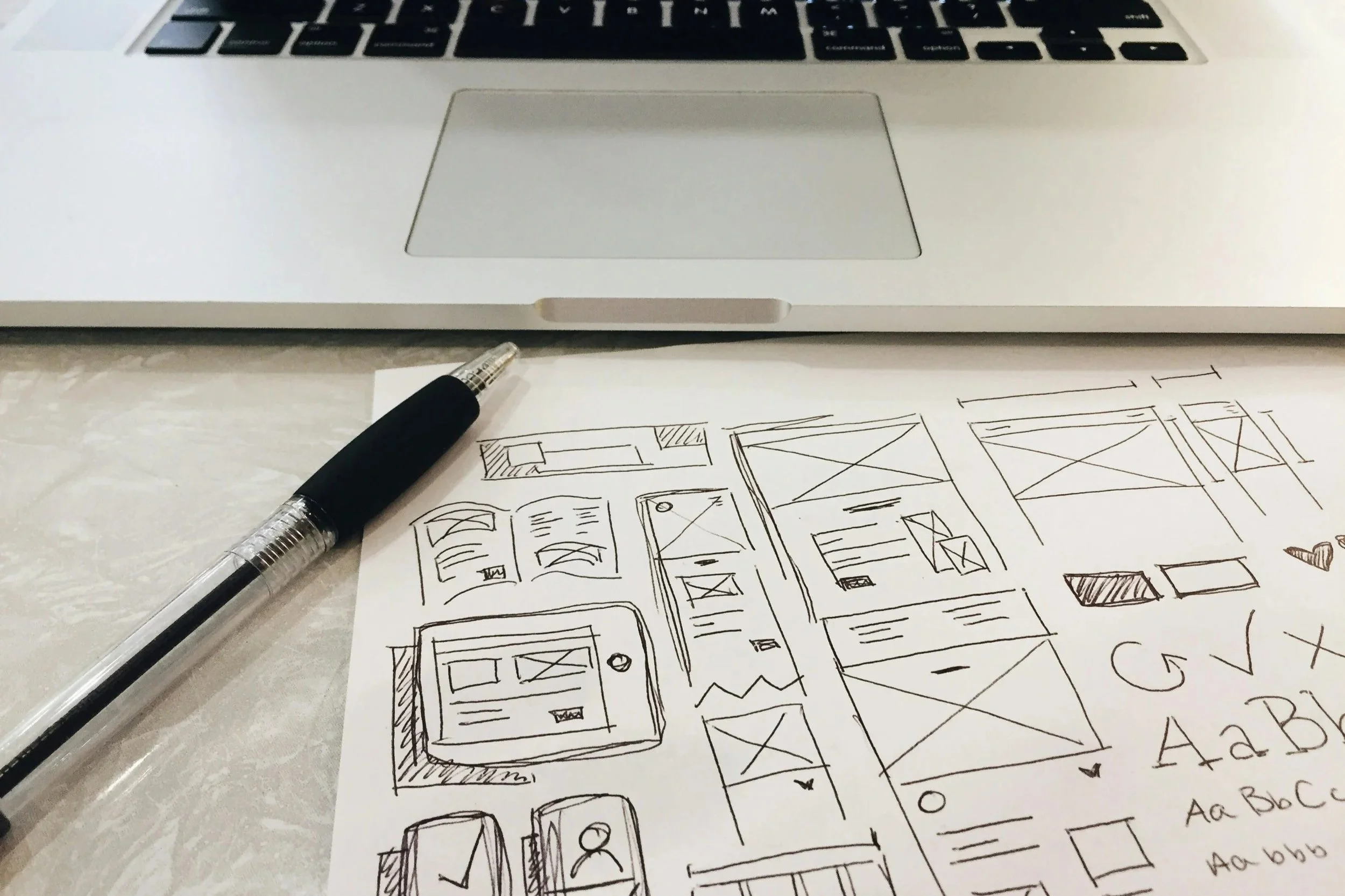
Custom web design means the structure gets designed for your business before anything is built. Wireframes come from your actual customer journey. Layouts get drawn rather than selected. Then the build happens: a hand-coded theme, a bespoke Squarespace or WordPress build with custom code, a headless CMS feeding a framework front end, or a heavily engineered commerce setup.
Custom does not automatically mean "built in React from scratch," and this is worth being precise about because agencies use the word loosely. A site can be custom-designed on a mainstream platform, where every layout is original but the CMS and hosting are standard. That's a very different cost and maintenance profile than a fully bespoke application, and it's the version most small businesses that need custom work should be buying.
The real reason to go custom is a functional requirement a template cannot satisfy. Some genuine ones:
An instant quote calculator that prices work from user inputs
A booking system tied to real technician availability across multiple crews
Inventory or pricing pulled live from an ERP or POS system
Member accounts with tiered access to content or downloads
A checkout flow with unusual steps, custom shipping logic, or B2B pricing rules
A brand with a distinctive visual identity that a grid-based layout would flatten
Notice that most of those are functional, not aesthetic. Wanting a site that looks different is a legitimate reason to invest in custom design work, but it's the weaker of the two motivations, because a skilled designer can push a template's visual identity much further than most business owners expect.
Templates cost far less upfront; total ownership costs narrow the gap
Upfront, out-of-the-box wins by a wide margin. Custom work costs more because it consumes more hours: discovery, wireframing, original design, development, testing, revisions. Nothing exotic about the math. Two projects with the same page count can differ by a factor of several times over based on how much of the structure had to be invented.
Total cost of ownership is the part most comparisons skip. Over three to five years, a website costs you more than the build:
| Cost factor | Out of the box | Custom |
|---|---|---|
| Initial build | Lower; fewer design and dev hours | Higher; structure is designed from scratch |
| Platform / hosting | Predictable monthly platform fee | Hosting plus possible license and service fees |
| Ongoing edits | Owner can often self-manage simple changes | Usually needs a developer for structural edits |
| Security and updates | Handled by the platform | Your responsibility or your agency's |
| Adding a new feature | Cheap if supported, impossible if not | Costly but almost always possible |
| Redesign horizon | Refresh is fast and inexpensive | Bigger project, longer lifespan |
Read that table with a clear eye and a pattern shows up. Out-of-the-box shifts cost from build to platform subscription; custom shifts cost from subscription to maintenance labor. Neither is free after launch, and the businesses that get burned are the ones who budgeted only for the build. If you're pricing this out for the first time, the ranges by provider type in the breakdown of what a small business website costs in Maine will save you a few uncomfortable quote conversations.
One more cost nobody puts in a proposal: the revenue you don't earn while the site is unbuilt. A four-month custom timeline costs you three extra months of a site that isn't generating leads. For a new business, that's often the biggest line item on the page.
Template sites launch in weeks, custom sites in months
Out-of-the-box launches in weeks; custom launches in months. The gap comes almost entirely from the front half of the project. A template build skips wireframing and original design because those decisions were made when the layout was created, so the work becomes content, brand application, and configuration.
Custom projects add discovery, wireframes, design rounds, client approvals, development, and QA on original code that has never been tested in the wild. Each stage needs your review, which means the timeline depends partly on how fast you respond. That's the hidden trade-off nobody warns you about: custom projects stall on client feedback more often than they stall on development.
Speed matters more than most owners think when they're comparing packages. A contractor who launches in July and starts collecting local search traffic through the fall is months ahead of one who launches in November, because local rankings need time to settle regardless of how the site was built.
Custom wins on flexibility, but modern platforms handle more than they used to
Custom wins here, but the win is narrower than it sounds. Modern platforms handle far more than they did five years ago: sizable product catalogs, memberships, courses, appointment booking, multilingual content, and structured blogs all work fine on a mainstream builder.
Where templates hit a wall:
Custom data relationships. Templates handle pages and posts. They struggle with connected records like a filterable equipment library tied to service areas.
Deep integrations. Zapier-style connections are easy. Live two-way sync with a proprietary system usually isn't.
Checkout logic. Hosted commerce platforms guard the checkout closely. Wholesale tiers, complicated shipping rules, and multi-vendor splits can be tough.
Page-level layout freedom. You work inside a section system. Reaching outside it means code, and code inside a template can break during platform updates.
Scalability gets confused with traffic, so worth separating: a hosted platform will handle your traffic. Squarespace and Shopify do not fall over because you had a good month. Scalability limits are about complexity, not visitors.
There's also a scaling path most comparisons ignore, and it's the one worth planning for. Launch out of the box, learn from real customer behavior for a year, then invest in custom work on the two or three pages where the data says it matters. Redesigning after you know what converts costs less and produces better decisions than guessing up front. If you've already been through one build and it isn't working, the criteria in the piece on when a redesign is worth the money apply directly.
Custom builds ship faster code; templates load unused features
This is where the out of the box vs custom web design debate gets the most hand-waving, so here's the mechanism.
A custom build can be faster because you ship only the code your site uses. Templates load styles and scripts for every feature the layout supports, including the sections you deleted. That's code bloat, and it shows up in Core Web Vitals as slower rendering, especially on mobile over a weak rural signal. Custom builds also give you direct control over image handling, script loading order, and structured data markup.
But a custom build is only faster if the developer prioritized speed. Plenty of bespoke sites are slower than a clean Squarespace site because someone bolted on four tracking scripts and uncompressed hero images. Custom gives you control, not results.
And control over technical SEO is not what usually decides local rankings. For a plumber, an accountant, or a bakery competing in a defined geography, what moves the needle is service pages targeting real search terms, a properly configured Google Business Profile, consistent citations, reviews, and titles and headings that match what people type. Every mainstream platform gives you the controls to do all of that: editable meta titles, clean URL structures, alt text, sitemaps, redirects, schema for local business. The most common SEO mistakes on new business sites are strategy and setup problems, not platform problems.
Platform choice sets your technical ceiling. Content and local setup determine whether you get anywhere near it.
Custom becomes the stronger SEO play at scale: hundreds of programmatically generated location or product pages, complex faceted navigation that needs careful canonical handling, or a publishing operation where template constraints slow content production. Below that threshold, the SEO argument for custom is mostly theoretical.
Platforms handle maintenance and security for templates; you own it with custom
Out-of-the-box shifts maintenance risk to the platform. Squarespace and Shopify patch security, keep the servers running, and handle browser compatibility. When something breaks, it's usually their problem and it's usually fixed before you notice.
Custom builds put that responsibility on someone you pay. Dependencies need updating, plugins conflict, PHP versions get deprecated, and code written against a 2024 API breaks when the API changes. This is manageable with a support arrangement and genuinely risky without one. The most expensive custom sites are the abandoned ones: built beautifully, left alone for three years, then requiring a near-rebuild because nothing can be safely updated.
There's a related trap with custom code inside a template, worth naming since it's the middle path many businesses take. Code injection that overrides a platform's layout can break silently when the platform updates. It's fine if someone is watching. Nobody usually is, which is why ongoing support versus a one-time build is a more consequential decision than the template-versus-custom one for a lot of small businesses.
Ecommerce platforms manage transactions better than templates alone can
Selling online sharpens this comparison because the stakes move from presentation to transactions. For a store with a manageable catalog, standard shipping, and simple variants, a hosted commerce platform out of the box is close to unbeatable. You inherit a checkout that's been tested by millions of transactions, PCI compliance, tax calculation, abandoned cart recovery, and payment integrations you'd otherwise pay a developer to wire up.
Custom earns its cost in commerce when you hit specific walls: B2B pricing per customer account, product configurators with dependent options, subscriptions with unusual billing rules, live inventory across a warehouse and a physical shop, or a checkout you need to redesign in ways the platform won't allow. Platform lock-in is the real long-term consideration here, since migrating a store with order history, customer accounts, and hundreds of indexed product URLs is a serious project. Worth thinking about before you're locked in, not after.
Most Maine retailers and makers are better served starting with a hosted platform and a well-built ecommerce site, then adding custom work where volume justifies it.
List what your site must do to decide between them
Work through this in order and you'll usually have your answer in five minutes.
List what the site must DO. Not look like. Do. Write out every function a visitor performs and every system that needs to talk to your site. If the list is pages, forms, and maybe a booking link, out of the box handles it.
Check for a genuine blocker. Take each item and ask whether your platform of choice supports it natively or through an app. One hard no on something central to how you make money moves you toward custom. A no on something you'd like eventually does not.
Weigh timeline against opportunity. If you need leads this quarter, a four-month build is expensive in ways the invoice won't show.
Budget for years, not launch. Add platform fees, support, and content updates for three years. Compare totals, not build prices.
Be candid about who maintains it. No developer relationship and no support plan? Choose the option where a platform handles upkeep.
Choose out of the box for service businesses and standard customer journeys
You're a service business, local retailer, restaurant, studio, or professional practice. Your customer journey is browse, trust, contact or buy. You want to be live in weeks and you'd rather put the difference into ads, photography, or better copy. You're comfortable working inside a strong structure instead of inventing one. This describes the large majority of small businesses, and it's why the package options lead with it.
Choose custom when your business logic doesn't fit platform features
Your site performs a function central to your revenue that no platform supports. You have integrations with internal systems. Your brand identity is a real competitive asset and a section-based layout would blunt it. Or you've outgrown a template build and have the traffic data to know exactly what needs rebuilding.
Hybrid approach: custom design on a mainstream platform
You're between the two, which is common. A custom-designed build on a mainstream platform gives you original layouts and brand-specific pages with the platform still handling hosting, security, and updates. Costs more than a straight template build, far less than bespoke development, and it keeps your monthly upkeep predictable. For growing businesses that want a distinctive site without a developer on retainer, this is frequently the right call.
FAQ
Is out of the box or custom web design better for a small business?
Out of the box is the better fit for most small businesses. The out of the box vs custom web design choice hinges on functionality, and a typical small business site needs pages, forms, and clear calls to action rather than custom logic. You launch faster and spend less, and a designer can still make it look nothing like the template it started from.
Will a template site rank as well as a custom one?
For local and small-business search, yes. Rankings in a defined geography are driven by service page content, Google Business Profile setup, citations, and reviews. Mainstream platforms give you full control over titles, meta descriptions, URLs, alt text, and schema. Custom builds gain a technical edge at large scale, with hundreds of pages or complex faceted navigation.
Can I start with a template and go custom later?
Yes, and it's often the smartest sequence. Launch, gather a year of real behavior data, then invest custom effort in the specific pages that need it. Keep your content organized and your brand assets consistent and the migration stays manageable. Plan for it rather than treating it as an emergency.
What does out of the box cost compared to custom?
Custom typically costs several times more upfront because it takes many more design and development hours. Ongoing costs run closer together than people expect: templates carry a platform subscription, custom builds carry hosting plus maintenance labor. Compare a three-year total rather than build prices alone.
How do I know if I have a real custom requirement?
Write down every function your site must perform, then check each against your platform's native features and available apps. A hard no on something central to how you earn money is a real requirement. A hard no on something you might want in two years usually isn't yet.
Write a function list before gathering quotes
Before you gather quotes, write the function list. Two columns: what the site must do, and what you'd like it to do someday. That single page turns out of the box vs custom web design from an abstract debate into an answer, and it also gives any designer you talk to something concrete to price against instead of guesswork.
If you're not sure which column an item belongs in, that's usually the conversation worth having. Send over the list and the Maine web design team can tell you whether it calls for the out of the box vs custom web design, or something in between.